
Central Kitchen Cooking Equipment Selection Guide
What you are choosing is not just a wok — it's a "production line" capable of steadily delivering standardized products while running at high intensity over the long term. The core logic of selection is shifting from "rule by people" to "rule by systems," making equipment the infrastructure that guarantees consistent output and efficiency.
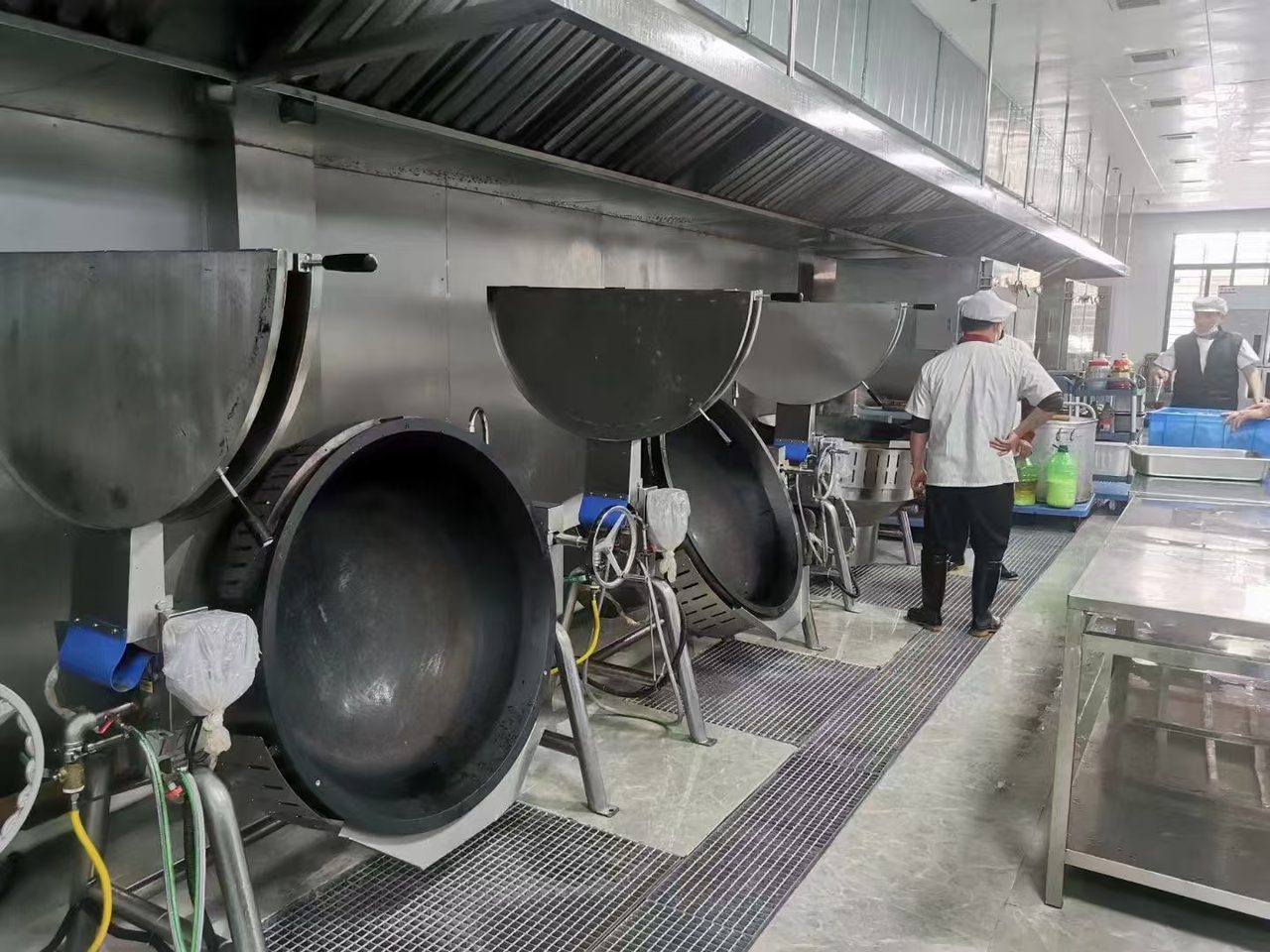
Central Kitchen Cooking Area
I. Classification of Core Cooking Equipment and Key Selection Points
Based on the processing flow of a central kitchen, cooking equipment falls into the following major categories. During selection, focus on three key indicators: capacity matching, temperature control precision, and continuous operation capability.
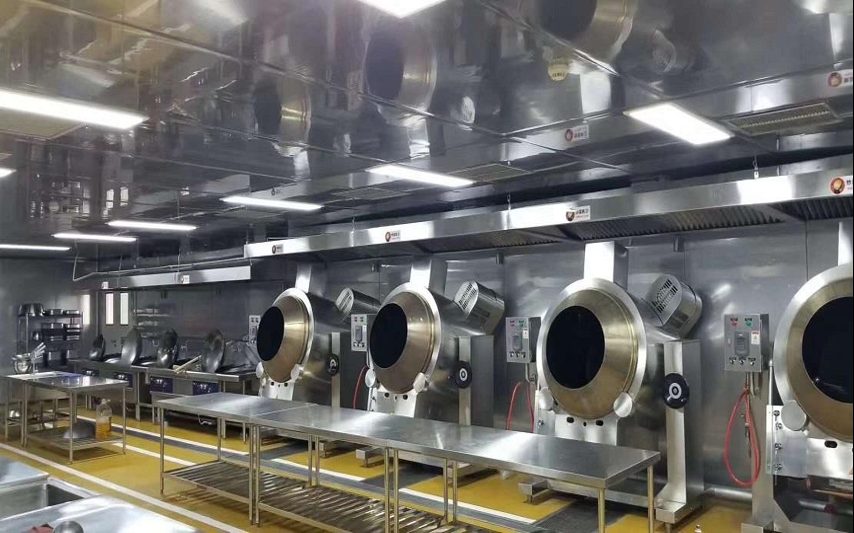
Intelligent stir-frying machine: temperature control precision and continuous operation capability are the core of standardization
II. Four Core Dimensions of Equipment Selection
1. Output and Efficiency Dimension: Calculate Capacity First, Then Match Equipment
Capacity matching: Based on daily meal portions and peak-hour output, calculate the required number and specifications of equipment. For example, a single four-wok robotic stir-frying machine produces about 700 portions per day, which can serve as a baseline estimate.
Concurrent serving capability: Chain fast-food and group-meal peak periods are concentrated; assess whether equipment can handle multiple orders simultaneously to avoid "wok bottlenecks."
2. Standardization and Consistency Dimension: Can a Beginner Produce Master-Level Taste?
Temperature control precision: The essence of Chinese-style stir-frying lies in heat control. Temperature control algorithms and temperature-hold technology keep oil temperature fluctuation within an extremely small range, ensuring consistent output across batches.
Recipe reproducibility: Whether the equipment supports programmed recipe storage and recall, ensuring consistent taste across different stores and different staff.
3. Energy and Cost Dimension: Gas or Induction?
Gas equipment: High heat output, ideal for flash-frying, but requires gas pipeline installation, 3C certification, and ventilation safety considerations.
Induction equipment: Energy-saving, no open flame, safe — suitable for venues with open-flame restrictions (e.g., schools), though initial investment is higher.
Total operating cost: Calculate long-term cost changes from energy consumption, maintenance, and labor substitution.
4. Reliability and Maintenance Dimension: Continuous Operation Is a Hard Threshold
Continuous load testing: Require suppliers to provide test data from 72+ hours of continuous operation, and evaluate failure rates and maintenance cycles.
Ease of cleaning: Smooth surfaces without dead corners facilitate daily cleaning and disinfection.
After-sales service: Whether the supplier can provide rapid response, spare parts supply, and training support.
III. Selection Recommendations for Different Scenarios
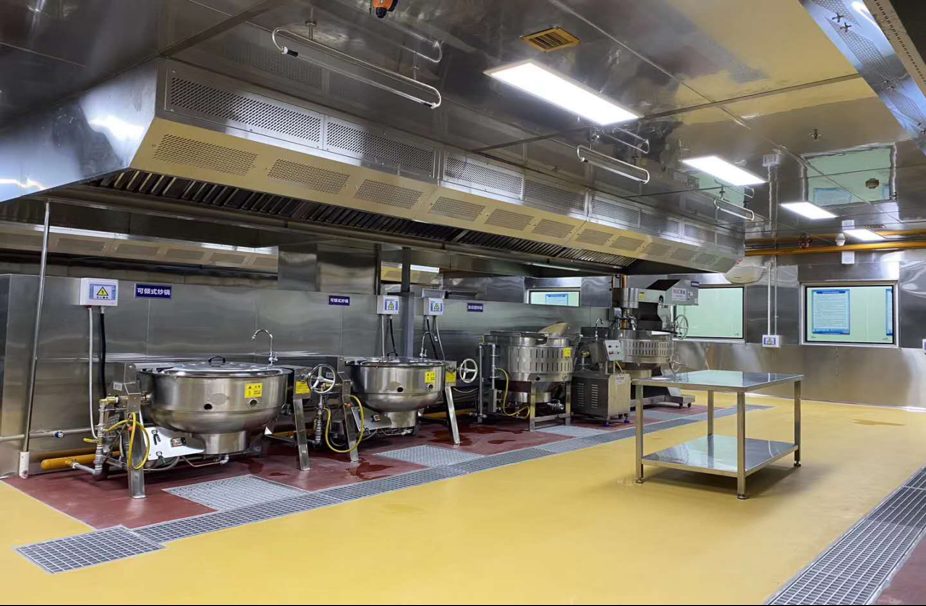
Group-Meal Central Kitchen
IV. Practical Selection Recommendations
1. On-site inspection and testing: Ask suppliers for continuous load test results or existing customer cases; ideally, observe the actual operation of a real store or central kitchen.
2. Supporting system planning: Equipment selection must be coordinated with clean vegetable processing, exhaust systems, and workflow design to avoid "equipment islands."
3. Reserve expansion space: New products or capacity expansion may come in the future; reserve power capacity, interfaces, or workstation space during selection.
4. Compliance check: Gas equipment must have 3C certification; exhaust systems must meet local environmental emission standards.
V. Equipment Selection Cannot Be Separated from Central Kitchen Design Planning
Equipment selection is never an isolated step. Many central kitchen projects end up with "equipment that doesn't fit, insufficient power, or chaotic workflows" — the root cause is buying equipment first and designing later. The correct logic is: develop the central kitchen design plan first, then select equipment — giving every piece of equipment its position, its utilities, and its workflow.
Only when equipment selection and design planning advance together can the "production line" truly run. Kitlalong Commercial Kitchen Design specializes in central kitchen and commercial kitchen spatial design, providing complete design solutions from floor plan flowcharts, equipment layout plans, and MEP drawings to 3D renderings of central kitchens — helping foodservice companies get equipment selection, space planning, and workflow design right the first time, avoiding detours and wasted spending.
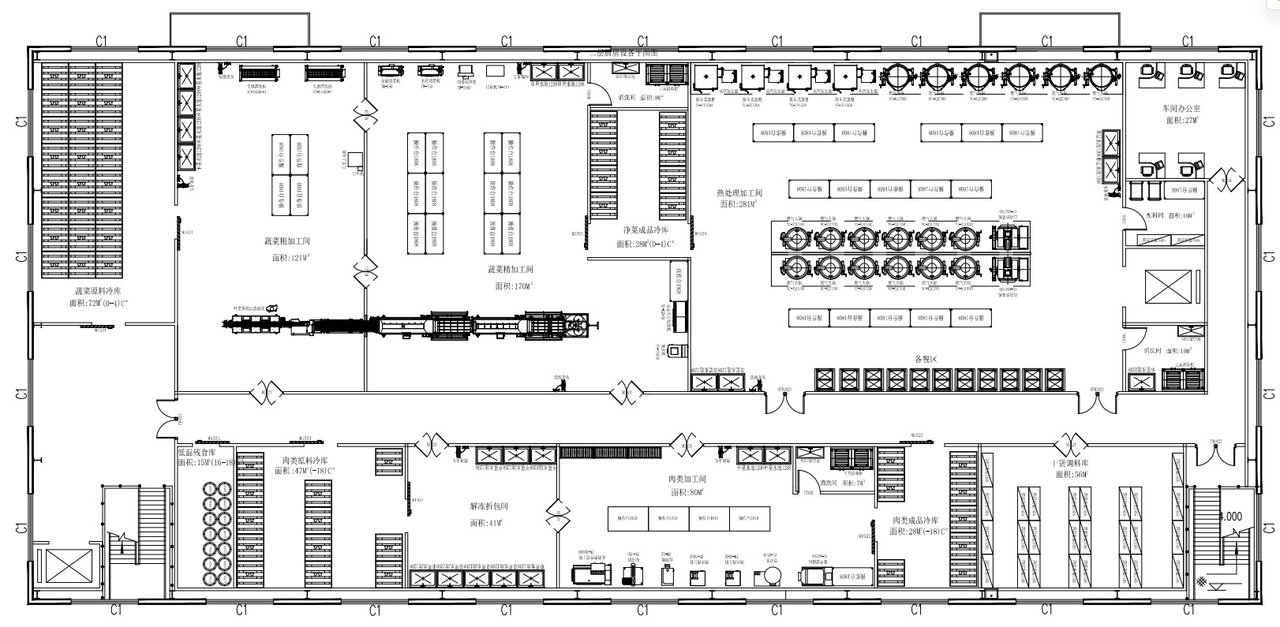
Central Kitchen Floor Plan
Floor plan flowchart: First map the complete process flow from receiving, storage, primary processing, cutting and preparation, cooking, to output and washing/disinfection, clarifying the connections between each step to avoid workflow crossings and backtracking.
Equipment layout plan: Based on process flow and capacity requirements, place every piece of equipment on the drawing, verifying equipment dimensions, operating clearances, aisle widths, and ergonomics — eliminating "doesn't fit, can't reach, can't pass" from the source.
MEP drawings: After equipment selection is confirmed, plan water, electricity, gas, exhaust, and fresh-air points simultaneously, ensuring power loads and utility routes correspond one-to-one with equipment to avoid rework later.
Central kitchen 3D rendering: Visually present the spatial effect before construction, facilitating communication, adjustment, and confirmation — aligning expectations among investors, operators, and designers before work begins.
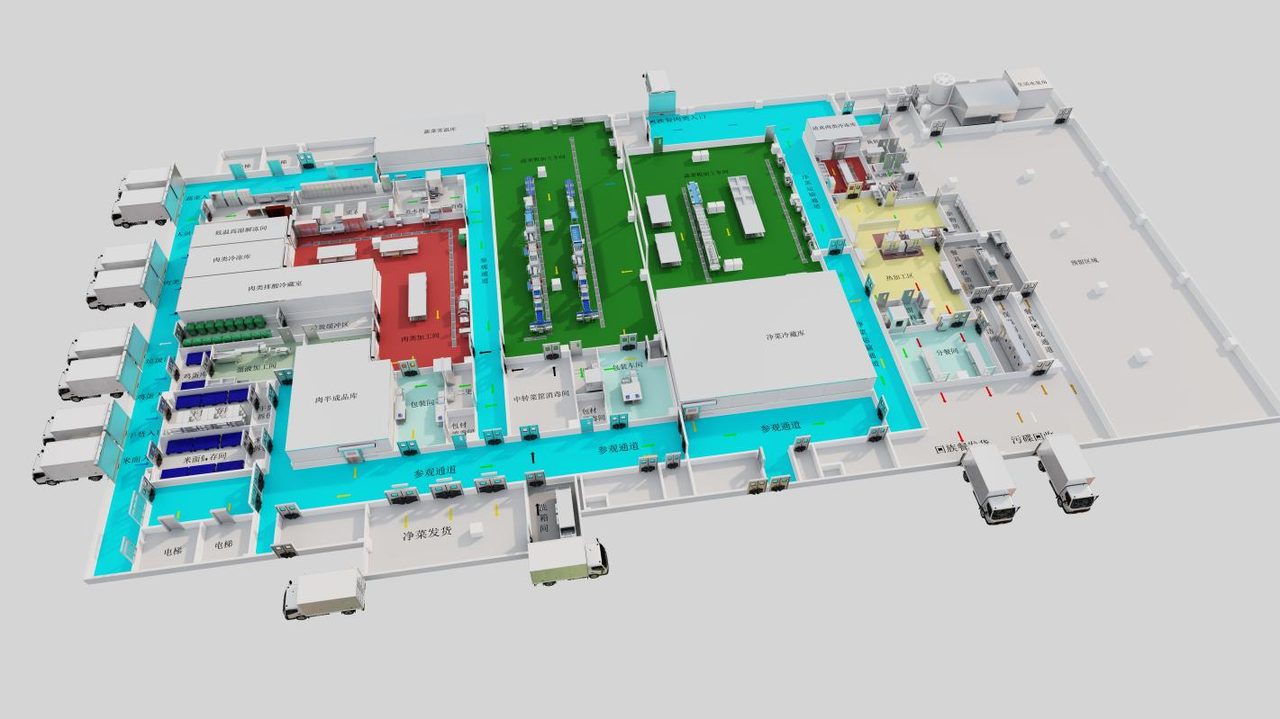
Kitlalong Commercial Kitchen — Central Kitchen Rendering
Summary
Central kitchen cooking equipment selection is essentially the process of translating dish craftsmanship into equipment parameters and business goals into equipment capacity. After determining your specific meal scale and signature dishes, we recommend inviting 2–3 mainstream suppliers for solution comparison and on-site testing — let actual operating data speak.